


OpenAI
OpenAI is an artificial intelligence (AI) research company that researches and develops artificial general intelligence (AGI).
Integrations and Connectors
AgilePoint NX integrates in these ways with OpenAI:
- Activities in Process Builder
- AI Control Towers
- Lookups in eForm Builder
- Access tokens
Activities in Process Builder
You can use out-of-the-box activities for OpenAI to execute actions in process-based apps.
An activity is a functional unit, or task, in a process-based app. Activities that integrate with a third-party system provide access to the API functionality for that system in a simple, point-and-click, form-entry format. This means that you can easily leverage APIs without writing code.
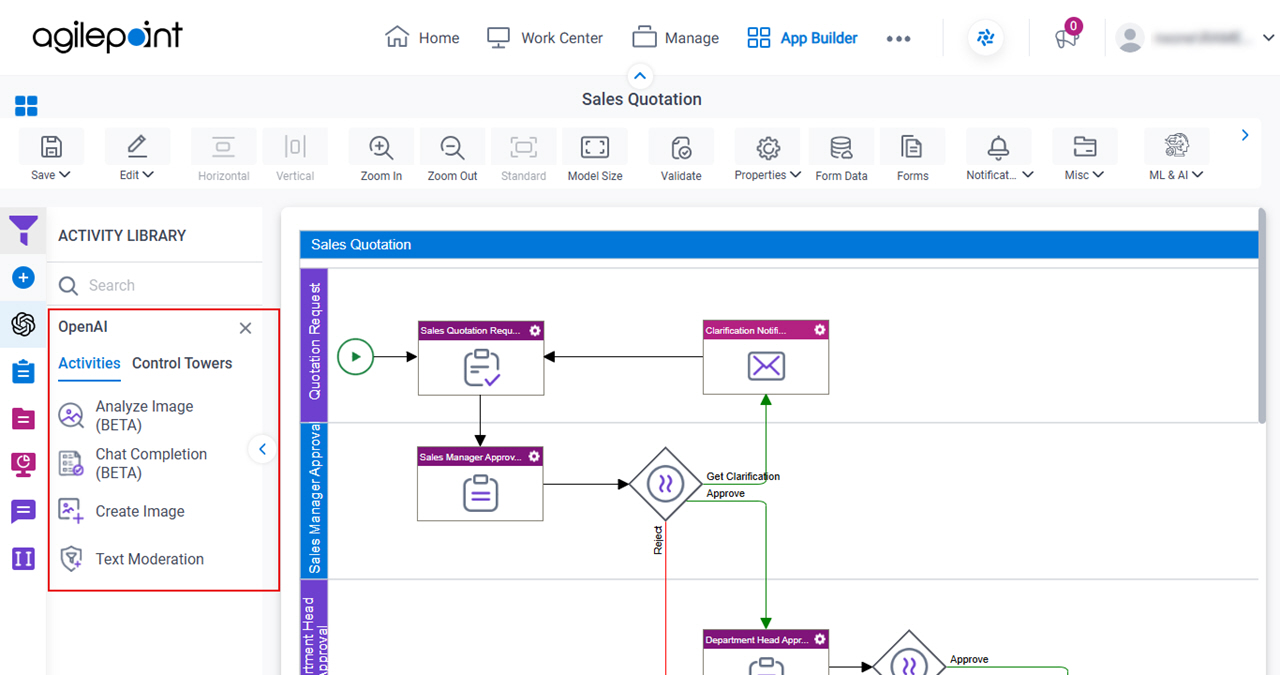
The following activities are available for OpenAI:
- Analyze Image
- Chat Completion
- Create Image
- Text Moderation
For more information, refer to the process activities for OpenAI in Process Builder.
AI Control Towers
You can use OpenAI AI Control Towers to orchestrate operations within your apps.
An AI Control Tower is a process activity used for robust, secure monitoring that work with predictive AI to improve workflows with dynamic, predictive capabilities. These predictive AI agents enable real-time monitoring, control, and adaptation for process instances, dynamically adjusting them based on AI-driven predictions. AI Control Towers seamlessly handle AI agent integration and orchestration across multiple apps. AI Control Towers also provides centralized, real-time monitoring and analytics features that leverage AI to help organizations oversee their operations, improve governance, and optimize their business processes.
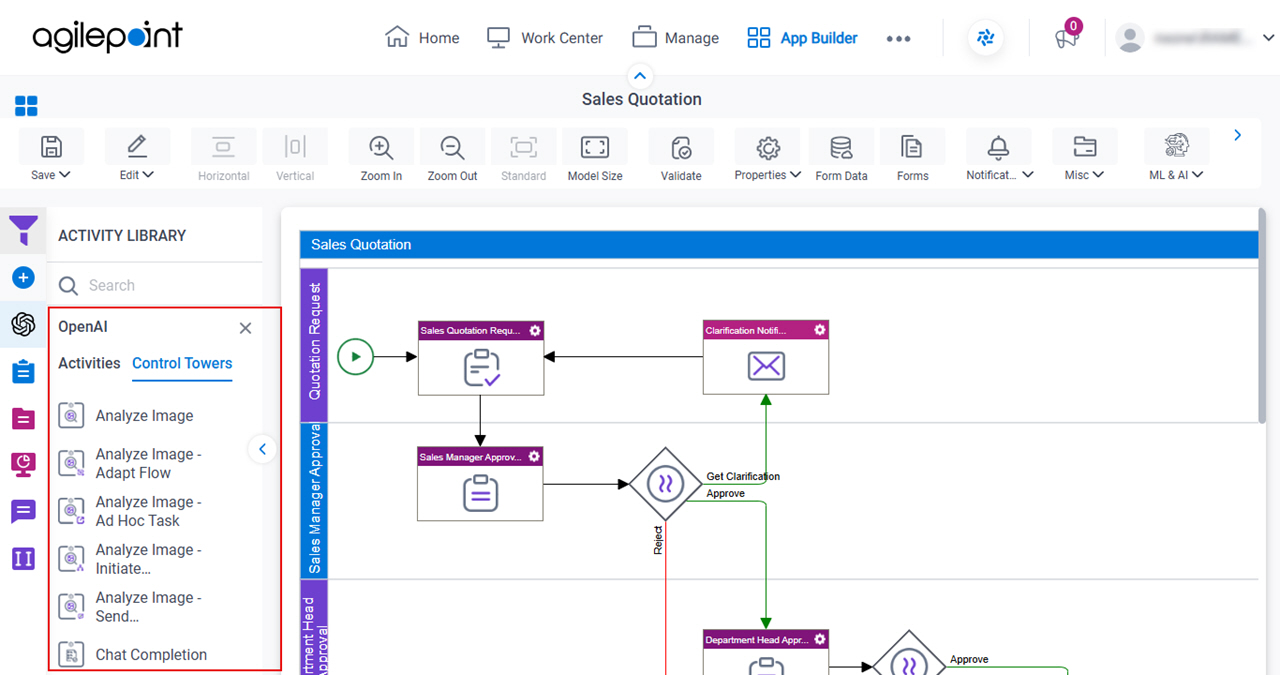
The following AI Control Towers are available for OpenAI:
- Analyze Image
- Analyze Image - Adapt Flow
- Analyze Image - Ad Hoc Task
- Analyze Image - Initiate Subprocess
- Analyze Image - Send Notification
- Chat Completion
- Chat Completion - Adapt Flow
- Chat Completion - Ad Hoc Task
- Chat Completion - Initiate Subprocess
- Chat Completion - Send Notification
For more information, refer to the AI Control Towers for OpenAI in Process Builder.
Lookups in eForm Builder
You can create lookups for OpenAI in eForm Builder and form-based apps.
A lookup is an automated procedure that retrieves data from an external data source, such as a database or third-party service, to display runtime. For example, you can use a lookup to populate the options in a list on an eForm.
For more information, refer to OpenAI lookup configuration.
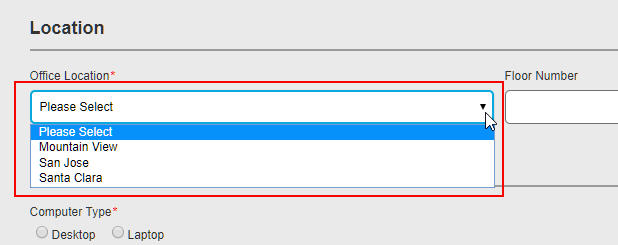
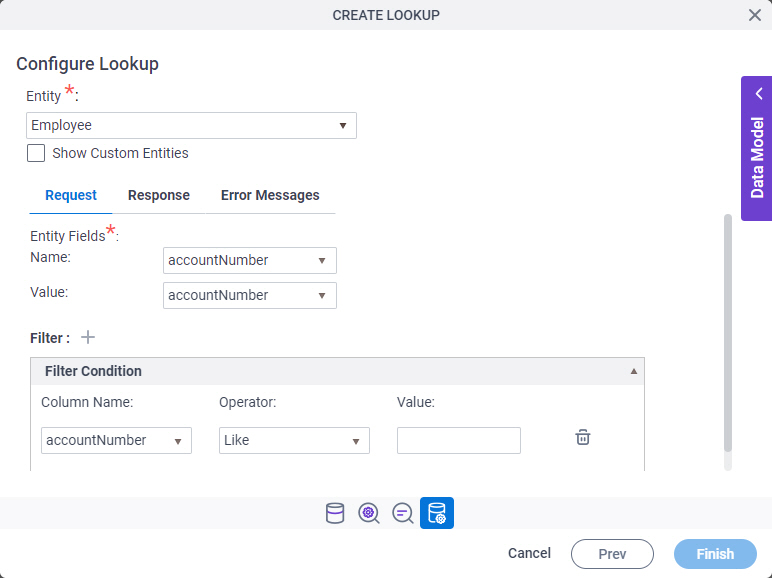
This image is only one example configuration screen from the Auto-Lookup form control. It does not show all the configuration options, and lookups can be configured and executed in multiple ways. The Auto-Lookup control can perform a lookup for eForms or other controls. However, many other form controls have built-in lookup capabilities — for example, the Drop-Down List form control. For information about how to configure lookups, refer to eForm Controls.
Access Tokens
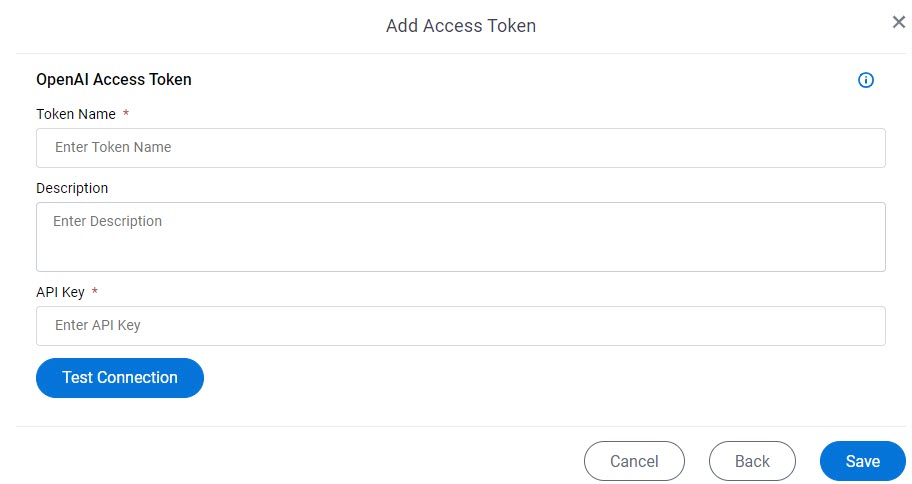
You can create access tokens for OpenAI.
An access token is a secure object that stores an endpoint (usually a URL) and authentication credentials to connect to a service or technology. Often this is an external or third-party service, like Salesforce or SharePoint, but access tokens can also connect to an AgilePoint NX enviornment, local database, or other types of technologies. Once an access token is created, app designers can simply select and reuse it, rather than entering the credentials each time they are needed.
For more information, refer to Access Token for OpenAI.
Related Topics
- OpenAI > Activities tab - Process activities
- OpenAI > Control Towers tab - AI Control Towers
- OpenAI lookup configuration
- Access Token for OpenAI
Examples
- (External) AgilePoint NX Connector For OpenAI
- (External) AgilePoint Announces AI Control Tower Support for OpenAI
- Examples - Step-by-step use case examples, information about what types of examples are provided in the AgilePoint NX Product Documentation, and other resources where you can find more examples.
OpenAI Documentation
Use these links to find third-party vendor documentation for OpenAI:
About This Page
This page is a navigational feature that can help you find the most important information about this topic from one location. It centralizes access to information about the concept that may be found in different parts of the documentation, provides any videos that may be available for this topic, and facilitates search using synonyms or related terms. Use the links on this page to find the information that is the most relevant to your needs.
Keywords
OpenAI, ChatGPT, OpenAI, LLM, large language model, artificial intelligence, AI